SMBs
Teams of 1 to 50 people that need a real marketing engine, not a patchwork of freelancers.

AI marketing strategy
We help your team decide where AI belongs in your marketing, then put it to work. Strategy, audience research, content, distribution and measurement are planned as one system, with a 90-day plan your team can run. It is built on the 500 plays in Tarek Riman's book on AI marketing.
An AI marketing strategy is a plan for where AI tools fit into your marketing and what they should change: faster research, better content, sharper targeting and clearer measurement. A good one starts with your positioning and your customers, not with tools. We use a five-layer framework (strategy, audience, content, distribution and measurement) and tie every AI use to one scorecard.
Who it is for
Teams of 1 to 50 people that need a real marketing engine, not a patchwork of freelancers.
Teams of 50 to 500 ready to put AI to work across marketing.
Fortune 500 teams that need AEO, GEO and AI strategy expertise next to existing functions.
From pre-launch through growth.
The problem
The tools are not the hard part. Focus, ownership and measurement are.
Teams buy subscriptions and run experiments with no shared goal, so nothing adds up.
AI makes it easy to publish more. Without a point of view and evidence, it sounds like everyone else.
AI work sits between marketing, IT and leadership, and stalls in meetings.
Time saved and revenue gained are guesses, so budgets are hard to defend.
Plus the destination
We also build the destination: landing pages, marketing sites, e-commerce, web apps and mobile apps, designed to convert the attention your marketing earns.

Our approach
Wedge, positioning, OKRs, scenario planning and marketing moat mapping. AI-accelerated, founder-validated.
Voice-of-customer libraries, jobs-to-be-done, behavioural segmentation and real customer interviews.
AEO-ready answer modules, evidence ladders, SEO and GEO content, video and short-form repurposing.
SEO, AEO, GEO, paid (Google, Meta, LinkedIn), email, community and PR in one growth plan.
One scorecard: classic SEO, AEO citation share, GEO mention rate, paid efficiency and conversion.
Weekly check-ins, a shared prompt library, review rules and a monthly scorecard keep the system running after the plan is written.
Picking use cases
Most teams have a long list of AI ideas and no way to rank them. We score each one on four things: how often the task happens, how long it takes now, how easy the output is to check, and what happens if it is wrong.
Tasks that happen often and are easy to check go first. Tasks where an error reaches a customer or breaks a rule wait until review steps are in place. The result is a short list of two or three pilots, each with a baseline and an owner.

Deliverables
Timeline
How we work together
Pick the shape that fits your team. Most clients start small and grow from there.
You get a full strategy document, a 90-day plan and a scorecard.
Best for teams that can execute but need direction.
Strategy plus hands-on execution of your top one to three priorities, such as an AEO program, a content engine or an analytics build.
Best for teams that need results this quarter.
Monthly content, AEO and GEO programs, paid media and measurement.
Best for steady, compounding growth.
Embedded marketing leadership, one to three days a week, for growth-stage teams.
Best for teams not ready for a full-time CMO.
Web development, app development, book production, course creation and audit reports.
Best for a clear, one-time need.
IllustrationExample scenario
An illustration of how this kind of engagement usually runs. Not a client result.
Marketing, sales and support each use AI tools on their own. Content output went up, leads did not, and nobody can say what works.
Human review
Saying a human checks everything is easy. Making it happen needs a written checklist, a named reviewer and a place where approvals are recorded. Without those, review gets skipped in the first busy week.
A useful checklist is short. Check every number and quote against its source. Confirm names, prices and dates. Read it aloud for brand voice. Flag anything that sounds certain but has no evidence. Then approve it, or send it back with notes on what to fix in the prompt.

Tools we use
The buyer's guide
This guide covers the terms, the trade-offs and the questions to ask. It is for leaders and marketers who want AI to change results, not just output.
AI saves the most time on work that is frequent, repeatable and easy to check. Think research summaries, first drafts, ad variations, transcript clean-up and data tagging. A person can judge the output in minutes, so errors get caught.
AI helps least where the work depends on judgment nobody wrote down. Positioning, pricing and what to say in a sensitive moment still need people. The useful question for each task is simple: how fast can someone tell if the output is wrong?
Results come from changing the workflow, not from adding a tool. If a draft takes ten minutes but review still takes two hours, nothing improved. We redesign the steps around the tool: inputs, prompt, review, approval and where the output is stored.

The difference
| Compare | Ad hoc AI use | An AI marketing system |
|---|---|---|
| Starting point | A new tool someone found | Your positioning and your customers |
| Content | More of the same, faster | Fewer pieces, with evidence and a point of view |
| Ownership | Everyone and no one | A named owner and a weekly rhythm |
| Quality control | Whatever the tool produced | Review rules and a shared prompt library |
| Measurement | Hours saved, roughly | One scorecard tied to revenue |
FAQ
Still have a question? Ask us directly
No. In the programs we run, AI takes over first drafts, research and repetitive work, so people spend more time on strategy, customers and judgment.
It depends on your stack, budget and data rules. We usually start with the tools you already pay for, then add only what fills a real gap.
With a voice guide, a shared prompt library and review rules. Nothing AI drafts goes out without a human check, and claims need a source.
We set rules on what data can go into which tools, and prefer business plans that do not train on your inputs. Your legal and IT teams have the final say.
Senior marketing leadership one to three days a week, for teams that need direction but are not ready for a full-time executive.
Both. Most clients start with a strategy sprint, then keep us on to run the top priorities.
Yes. The AI Marketing Strategy Lab and the 500 Plays crash course are built for leadership and marketing teams.
Pick a task that happens often, takes real time and is easy to check. Content briefs, ad variations and call summaries are common starting points. Avoid tasks where a mistake reaches a customer before anyone sees it.
Start with off-the-shelf tools and the plans you already pay for. Build custom only when a tested workflow hits a real limit, such as needing answers drawn from your own documents. Custom builds need upkeep, so count that in the cost.
Not by itself. Google says it rewards helpful content however it is produced, while content made mainly to manipulate rankings breaks its spam policies. AI drafts still need accuracy, original insight and a real author added by people.
Time savings on a single task often show within a few weeks of a pilot. Changes in leads or revenue take longer, because they depend on what the saved time is spent on. We set both short and longer-term measures at the start.
Keep exploring
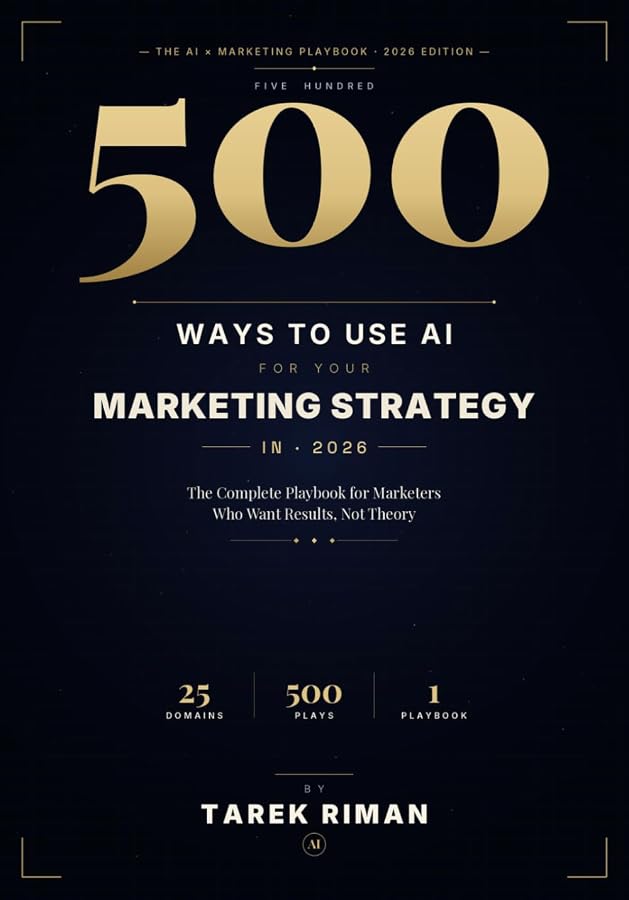
500 Ways to Use AI for Your Marketing Strategy in 2026
Book a free 30-minute strategy call. We review where you stand today and find the highest-leverage moves for the next 90 days across SEO, AEO, GEO and AI marketing.