Mid-market brands
Losing organic clicks to AI Overviews and needing to win back citation share.

AEO services
Answer Engine Optimization (AEO) is the work of making your content the answer AI tools quote. We restructure your key pages so Google AI Overviews, AI Mode, ChatGPT Search and Perplexity can lift a clear answer, trust the evidence behind it and cite your site.
Answer Engine Optimization (AEO) is the practice of making your content the most reference-worthy answer to real questions, so AI answer engines quote it and link to it. It builds on SEO, then adds three things: a direct answer near the top of each page, evidence the engine can verify, and a clear entity behind the content. Tarek Riman calls these the Citation Triangle: structure, evidence and entity strength.
Who it is for
Losing organic clicks to AI Overviews and needing to win back citation share.
Long research cycles where buyers ask AI tools to compare vendors before they ever fill in a form.
Ready to move from generic SEO to AEO-led visibility on the questions that bring in customers.
Launching AI-native businesses where being cited is the main growth channel.
The problem
Answer engines pick a few sources per question. Pages lose that spot for reasons you can fix.
The useful sentence sits in paragraph six, after the intro and the brand story. Engines pick the page that answers first.
Claims with no source, no date and no named author give an engine nothing to trust.
If the web is unclear about who you are and what you do, engines prefer a source they already know.
Without a fixed list of questions checked every week, you cannot tell whether anything is improving.
Why AEO matters now
AI Overviews, ChatGPT, Perplexity and Gemini now answer many questions directly, with a handful of cited sources shown above everything else.
The brands that get cited capture attention and trust before any classic result earns a click. Without AEO, you are missing from the questions that drive your business.
Our approach
We list the 50 to 200 questions that matter to your revenue, using the AEO Query Pyramid, sales calls, support tickets and community threads.
Each question is checked in AI Overviews, AI Mode, ChatGPT Search and Perplexity. We record who gets cited today.
Your top pages are scored against the Citation Triangle. Where competitors win, we note exactly why.
Priority pages get answer modules: Answer, Proof, Options, Next step. Short, specific and easy to quote.
Methodology notes, first-party data, author details, and FAQPage, Article, Person and Organization markup.
Citation share is re-checked every week. Patterns that win roll out to the next set of pages.
Voice answers
Voice assistants often read a single answer out loud. There is no list of options and often no link on a screen.
That rewards pages that state the answer in plain, spoken language. Write the first sentence so it makes sense read aloud on its own. Avoid tables, symbols and abbreviations in that sentence.
Voice questions tend to be longer and more conversational. Include the full question as a heading, and answer it in the words people say, not the words they type.

Deliverables
Timeline
Engagement models
Your top commercial pages audited against the Citation Triangle, with a prioritized 90-day AEO plan.
Best for teams that will do the writing themselves.
The audit plus execution on your top 20 pages and a measurement setup.
Best when you need citations this quarter.
Monthly content production, citation tracking and executive reporting.
Best for teams building a lasting AEO program.
Embedded with your team to build AEO into your existing SEO and content operations.
Best for larger content teams.
IllustrationExample scenario
An illustration of how this kind of engagement usually runs. Not a client result.
The company ranks on page one for its main category terms. When buyers ask ChatGPT or AI Overviews the same questions, competitors get cited instead.
Editing for citations
Most pages do not need a full rewrite. They need an edit with a few clear rules.
Move the answer to the top. Cut the warm-up paragraph. Replace vague words like many or often with a number and a source where you have one. Keep one idea per paragraph so any passage can stand on its own.
Then read each heading alone. If it does not tell you what the section answers, rewrite it as the question.

Tools we use
The buyer's guide
AEO is new enough that the words get used loosely. This guide sets out the terms, the traps and how to judge the work.

An AI tool has to trust a claim before it repeats it. Think of evidence as a ladder. Each rung makes a statement easier to verify.
The lowest rung is a bare claim. Above it are a named author, a date, a cited source, first-party data with a method note, and finally independent confirmation from other sites.
Pages that climb a few rungs give the engine something solid to quote. You do not need every rung on every page. Your most important claims should reach the upper ones.
Structure matters too. A clear answer in the first lines, a heading that matches the question and short paragraphs all make a passage easier to lift.



Three layers of visibility
They share one content spine, but each one answers a different question about how buyers find you.
| Compare | SEO | AEO | GEO |
|---|---|---|---|
| Goal | Rank in search results | Get cited inside AI answers | Get named by AI, even without a citation |
| Where it shows up | Google and Bing results pages | AI Overviews, AI Mode, ChatGPT Search and Perplexity | ChatGPT, Claude, Gemini and Perplexity answers |
| Main levers | Technical health, content and links | Answer structure, evidence and schema | Entity strength, third-party mentions and accuracy |
| Main metric | Rankings, clicks and conversions | Citation share on a fixed question set | Brand mention rate and accuracy |
| Short version | Be found. | Be cited. | Be chosen. |
FAQ
Still have a question? Ask us directly
SEO gets your page ranked in a list of results. AEO gets your content quoted inside the answer itself. AEO builds on SEO, because answer engines mostly cite pages that are already indexed, fast and trusted.
Google AI Overviews and AI Mode, ChatGPT Search, Perplexity and Gemini. The foundation is the same for all of them. Each one rewards slightly different formats, so we adjust per platform.
APON stands for Answer, Proof, Options, Next step. It is the structure of a short answer module: lead with the direct answer, back it with evidence, show the main options or conditions, then point to the next action.
We track citation share: the percentage of a fixed set of questions where your site is cited, checked on a regular schedule across each AI surface. We also watch branded search, referral traffic from AI tools and conversions from cited pages.
Pages that already rank can start getting cited within weeks of a rewrite. Building the evidence and entity strength behind a whole topic usually takes a few months.
No. AI engines change how they choose sources often, and nobody controls them. We commit to the work that makes citations more likely, and to measuring it honestly.
Yes. We run AEO bootcamps and content workshops, and most retainers include training so your writers can produce answer modules on their own.
No. AEO is about being cited as a source. GEO is about being named as a brand when AI answers without citing anyone. We usually run them together.
It can help machines read your questions and answers. Since 2023, Google shows FAQ rich results only for a small set of authoritative government and health sites. So add it where the page has a real Q and A, and do not expect a visual change in search.
It is optional. llms.txt is a proposal, not a standard, and support across AI tools is unclear. It is cheap to add, but clear pages, clean structure and crawler access matter far more.
Short enough to quote. We aim for a direct answer of two or three sentences, then proof and options below it. The rest of the page can go deeper.
Some questions get answered without a click, whether you are cited or not. Being cited keeps your name in front of the buyer. Buyers who do click from an answer often arrive further along in their research.
Keep exploring
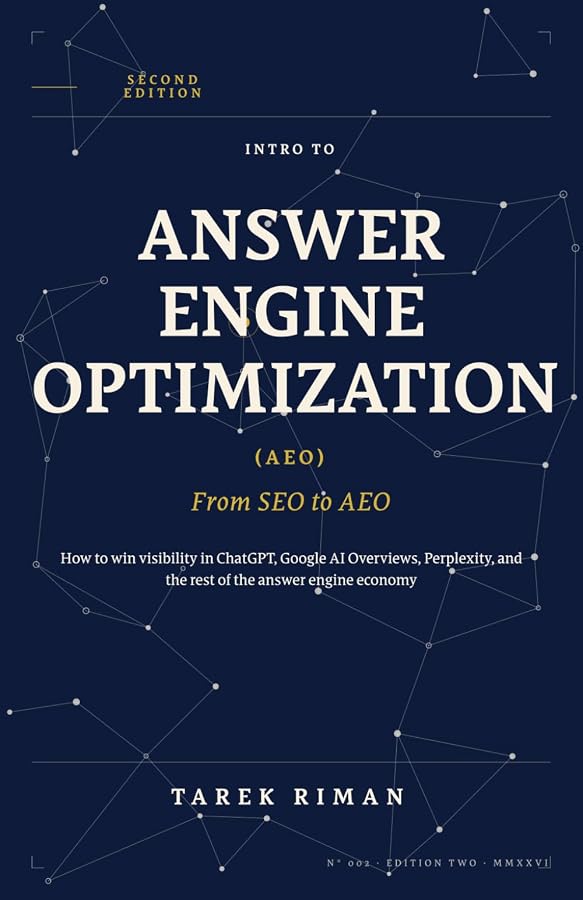
Intro to Answer Engine Optimization (AEO)
Book a free 30-minute AEO call. We review your top five commercial questions against the Citation Triangle and find the moves that matter most.