You rank, but AI ignores you
Established brands that are not named in AI category answers despite strong SEO.

GEO and AI search visibility
Generative Engine Optimization (GEO) makes sure ChatGPT, Claude, Gemini and Perplexity describe your brand correctly and name you when buyers ask who to choose. AEO earns you citations as a source. GEO earns you recognition as a brand. We run them together.
GEO is the work of shaping how AI models talk about your brand. When someone asks an AI tool for the best options in your category, the model often answers from what it learned across the open web, without citing a source. GEO strengthens that footprint: clear facts about your company, consistent profiles, trusted third-party mentions and structured data, so the model names you and gets the details right.
Who it is for
Established brands that are not named in AI category answers despite strong SEO.
New brands that want to show up in AI answers sooner.
Similar competitor names, outdated AI knowledge or the wrong company getting credit.
Teams ready to add the brand layer on top of their citation work.
The problem
Most GEO problems trace back to a few messy facts on the open web.
Buyers ask for the top options in your category and your name never comes up.
AI repeats an old tagline, a closed office or a service you stopped offering years ago.
A competitor with a similar name gets credit for your work, or the other way around.
Your site, LinkedIn, directories and press each describe you differently, so models cannot tell what is true.
Why GEO matters
When a buyer asks ChatGPT who they should work with, the engine often answers without citing a source. It names brands it already knows from the open web.
The brands named with confidence are the ones that built a strong entity presence over time. GEO is how you become one of them.

Our approach
The questions buyers ask AI about your category, your brand and your competitors, in each language you sell in.
Every prompt runs across ChatGPT, Claude, Gemini and Perplexity. We score mention rate, accuracy and position.
We list every place the web describes you: your site, schema, Wikidata, LinkedIn, directories, press and reviews.
One source of truth for your name, description, services, locations and people, pushed out everywhere it should appear.
PR, podcasts, expert quotes, Q&A answers and documentation that put accurate mentions on sites models learn from.
Same prompts, same models, compared to the baseline and to your competitors.
Arabic and English markets
Buyers in Dubai often ask AI tools questions in English and in Arabic. The answers can differ, so test both.
Pick one official Arabic spelling of your brand name and use it everywhere. Arabic names are often written several ways in Latin letters, and the reverse is also true. Mismatches split your entity.
Publish an Arabic version of your fact sheet and About page, written by a fluent writer. Keep your listings in both languages consistent with it.

Deliverables
Timeline
Engagement models
A fixed prompt set run across the major models, with a clear report on where you stand against competitors.
Best for a first look.
Baseline, entity map, fact cleanup and footprint building, with quarterly re-tests.
Best for brands that are missing or misdescribed.
Same content, two visibility lenses, one scorecard. Most clients run both.
Best for a full AI visibility program.
IllustrationExample scenario
An illustration of how this kind of engagement usually runs. Not a client result.
A professional services firm changed its focus two years ago. When people ask AI tools about it, they still hear the old positioning and an address that has closed.
Podcasts and PR
A podcast guest spot or an expert quote puts your name on a site you do not control. That is the kind of mention models learn from.
Make each one count. Send the host a short bio that matches your fact sheet. Ask for a show notes page with your name, role and company spelled correctly, and a link to your site.
Where the host agrees, publish a transcript or summary on your own site too. Spoken words become text that search tools can read.

Tools we use
The buyer's guide
GEO deals with something you cannot edit directly: what AI models say about you. This guide explains what you can influence and how to judge the work.
A model does not have one file about your company. It pieces you together from many sources: your site, your structured data, directories, press, reviews and forum posts.
When those sources agree, the picture is sharp. When they disagree, the model may blend you with a competitor, repeat old facts or leave you out.
GEO work is mostly about making the sources agree and making more of them exist. Start with your own site and schema. Then fix the profiles you control. Then earn mentions on sites you do not control.
Results move at different speeds. Live retrieval can reflect changes in weeks. Training data changes only when a model is updated.

Three layers of visibility
They share one content spine, but each one answers a different question about how buyers find you.
| Compare | SEO | AEO | GEO |
|---|---|---|---|
| Goal | Rank in search results | Get cited inside AI answers | Get named by AI, even without a citation |
| Where it shows up | Google and Bing results pages | AI Overviews, AI Mode, ChatGPT Search and Perplexity | ChatGPT, Claude, Gemini and Perplexity answers |
| Main levers | Technical health, content and links | Answer structure, evidence and schema | Entity strength, third-party mentions and accuracy |
| Main metric | Rankings, clicks and conversions | Citation share on a fixed question set | Brand mention rate and accuracy |
| Short version | Be found. | Be cited. | Be chosen. |
FAQ
Still have a question? Ask us directly
AEO gets your page cited as a source inside an answer. GEO gets your brand named, and described correctly, even when the answer cites no one. They use the same content, so we usually run them together.
Not directly. Nobody can edit a model. What you can change is the information models learn from and retrieve: your own site, your structured data and what trusted third parties say about you. Over time, that is what shifts the answers.
Models that search the web can reflect changes within weeks. Answers that rely on training data change when models are retrained, which can take months. That is why we re-test every quarter.
A list of questions that stays the same from test to test, so changes in the answers reflect real movement and not different wording.
Not always. Many businesses are not eligible, and that is fine. Wikidata, consistent profiles, schema and credible press coverage often matter more for a business your size.
Yes. Models answer differently in each language, so we test and build in every language you sell in.
No. Nobody controls how AI models answer. We commit to the work that makes accurate mentions more likely, and we show you the before and after.
It can. Blocking search bots such as OAI-SearchBot or PerplexityBot can keep your pages out of live answers in those tools. Training bots such as GPTBot are a separate choice. Google-Extended controls use of your content for Gemini training, and Google says it does not affect Search.
They can. Reviews are public text that models may read and summarize. A steady flow of recent, specific reviews gives models more accurate material, and replies show you are active.
Not in the organic answer. Some AI surfaces show labelled ads, but an ad does not change what the model says on its own. Organic mentions come from your footprint on the web.
Your official name, a one-sentence description, your services, locations, founding year and leaders. Write it in plain facts that any profile can copy. Link it to your official profiles with schema.
Keep exploring
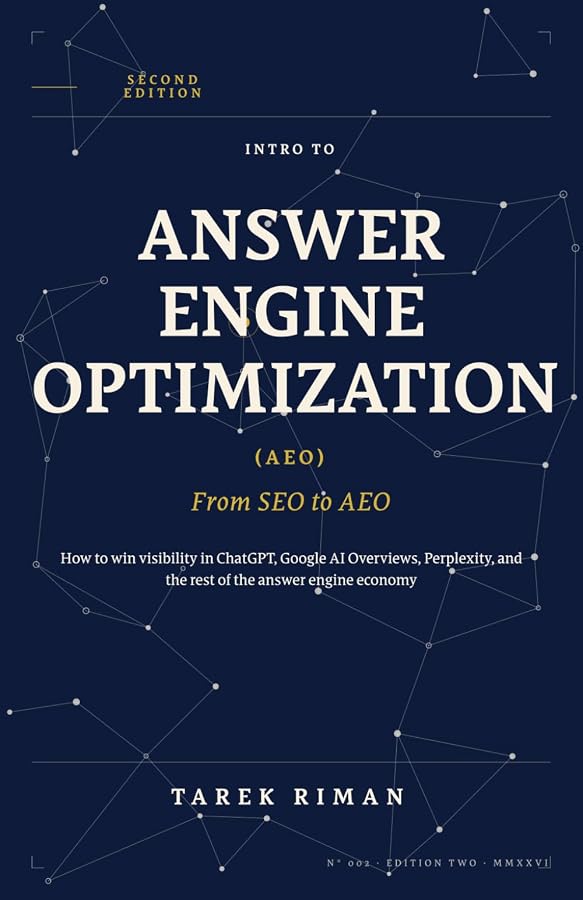
Intro to Answer Engine Optimization (AEO)
Free 30-minute baseline: we run a fixed prompt set for your category across the major AI engines and show you where you stand against competitors.